Week of November 9, 2026: Financial Services Ad Creative Trends
Data as of November 9, 2026, from the Closad weekly market report.
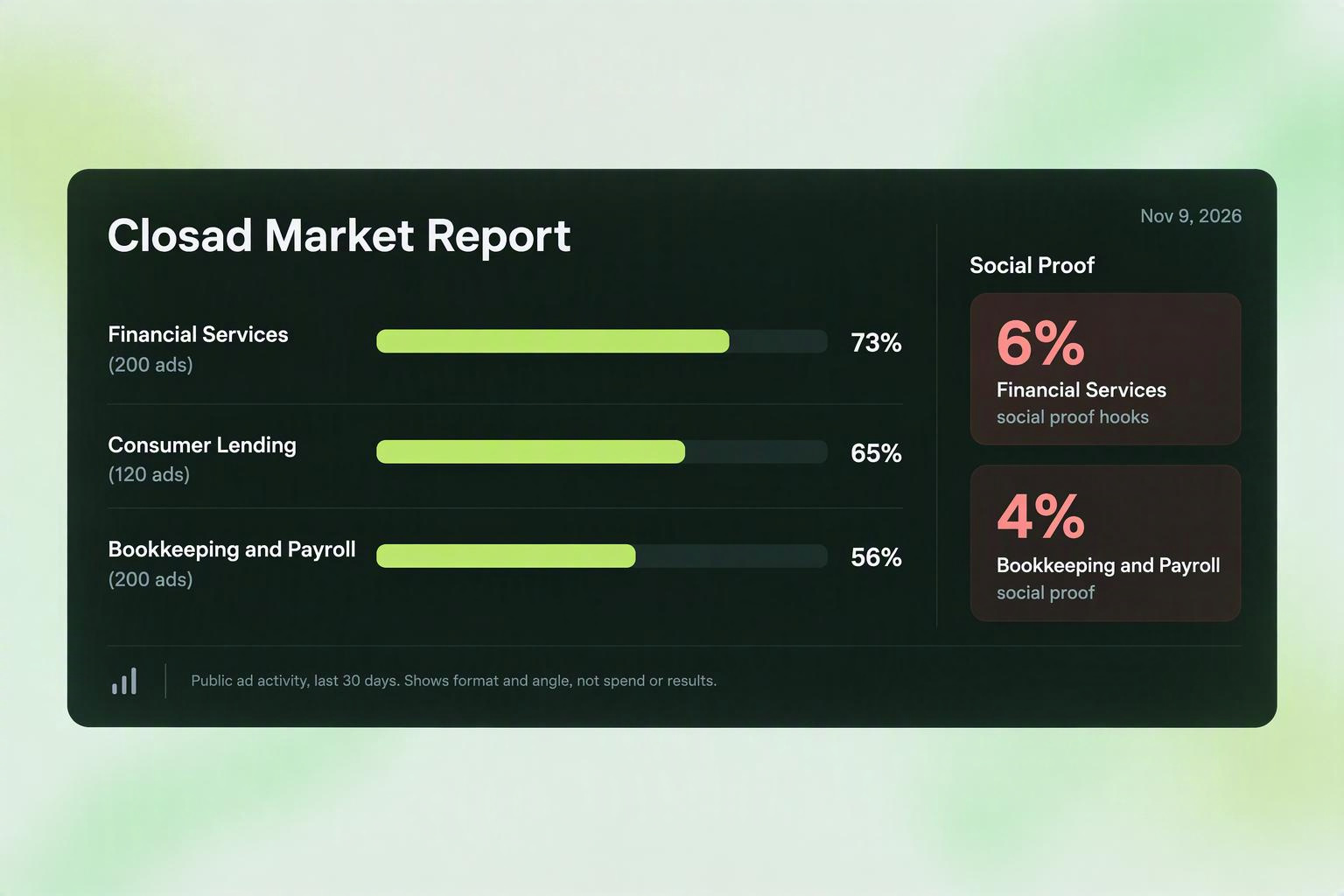
Of the 200 most recent Financial Services ads in this week's Closad market report, 73% ran as dynamic creative. Social proof hooks opened 6% of them.
The sample is built that way on purpose. Every week, we pull the 200 most recent ads in each category from the US ads Closad tracks across Facebook, Instagram, YouTube and Google, then classifies each one by format, hook and angle. Capping the sample at the newest ads keeps the read on what a category is shipping this month, without averaging in creative that stopped running weeks ago.
Those two numbers describe a category where the ad platform assembles nearly every ad and almost none of those ads show another customer. For a purchase where trust is the main barrier, that's an odd place for an entire category to land.
The same shape shows up in the neighboring money verticals this week.
In the 200 most recent Bookkeeping and Payroll ads from the same report, 56% were dynamic creative and 65% ran a problem-solution angle. Problem statements opened 39% of them, direct offers 27%. Social proof showed up in 4%.
Consumer Lending came in under the cap, with 120 ads in this week's sample. Of those, 65% were dynamic creative. Video accounted for 16%.
The broader Financial Services industry view, which pulls its own 200 most recent ads across every finance tag, comes in at 79% dynamic creative.
FinTech, Banking, Insurance, Payments and Trading Platform all point the same direction on social proof. This week's export doesn't list their sample sizes, so their numbers stay out of this piece.
What the Split Can't Tell You
None of this tells you what's working. Public ad activity shows how brands build and ship creative: format, hook, angle. It doesn't show spend, ROAS or whether a single one of these accounts is profitable. A 73% dynamic share describes production method. Budget weight is a separate question the public data can't answer.
Why Dynamic Creative Fits Regulated Categories
What the split does suggest is a shared operating constraint, and the constraint is often compliance.
Dynamic creative fits regulated categories for a mechanical reason. Legal reviews a fixed library of headlines, rate lines, body copy and disclaimer text once, and the delivery system recombines approved parts without anyone reopening a ticket. Every new combination inherits the approval.
A testimonial breaks that model. It's a single asset with its own review, its own substantiation question and, under the FTC's endorsement rules, its own exposure if the result it describes isn't typical. In lending, Regulation Z adds another layer: an ad that states a payment amount or a finance charge generally has to carry the full rate and terms disclosure with it. Rate-swap modules with a pre-approved disclosure asset handle that cleanly. A customer talking on camera about their monthly payment does not.
Targeting is the other part.
Ads that fall under Meta's special ad category for financial products and services run with restricted targeting. Age, gender and ZIP code targeting go away, and detailed targeting gets trimmed. When the audience levers are limited, creative variation does more of the sorting. Feeding the system more combinations is one of the few inputs left, which tends to push a category toward dynamic formats whether or not the creative team chose that on purpose.
So the category consensus may simply be the path of least resistance through legal review and a restricted auction. That matters for a brief, because consensus driven by constraint usually leaves the same gap open for everyone.
Putting Proof Inside the Modules
The obvious move is "run more testimonials." I'd push back on that framing. A standalone UGC ad in this category means a new approval cycle, a new disclosure check and, in many accounts, a separate ad set that has to exit learning on its own. That's heavy overhead for a single test.
The cheaper test puts proof inside the modules the category already uses.
Treat social proof as a component, not an ad. A review count line, a third-party rating line, a short customer quote that legal clears once: each one goes into the asset library next to the rate lines and headlines. The system then judges proof against everything else on the same terms, and you get a read on whether it moves anything without building a separate campaign around it.
For Bookkeeping and Payroll, where 65% of the ads in the sample already run a problem-solution angle, the natural slot is the second line. The problem statement opens, the proof line answers "who else had this problem." That keeps the hook the category already uses and changes the part almost nobody touches.
Consumer Lending has a different opening. With video at 16% of the 120 ads in the sample, a short explainer that walks through how terms work, before any rate appears, is a format most of the category isn't running. Keep it general enough that it doesn't state trigger terms, or route it through the same disclosure module the static rate ads use.
Reading It Against Your Own Competitors
When I read a split like this, the first thing I check is whether the category average matches my actual competitor set. A category number blends every brand tracked under that tag. Three direct competitors can sit well above or well below it, and your brief should answer the brands you share an auction with, not the average.
The second check is the next report. If social proof share in Financial Services moves off 6% over the coming weeks, someone else read the same gap. If it doesn't, the constraint is holding and the gap stays open for whoever builds the approved proof modules first.
A hypothetical, to make the cost concrete: a payroll software team with 30 approved components in a dynamic setup adds three proof lines. That's one legal review, no new campaign and no new learning phase. The same team building three standalone testimonial ads is looking at three reviews, three disclosure checks and a new ad set. The first version is usually the one that clears compliance before the quarter ends.
Closad updates every day and sends a brief every Monday. See which brands in your category are running proof: Start Trial